
Real Estate Commission in Christchurch: What It Really Costs to Sell
-
1st Feb, 2026
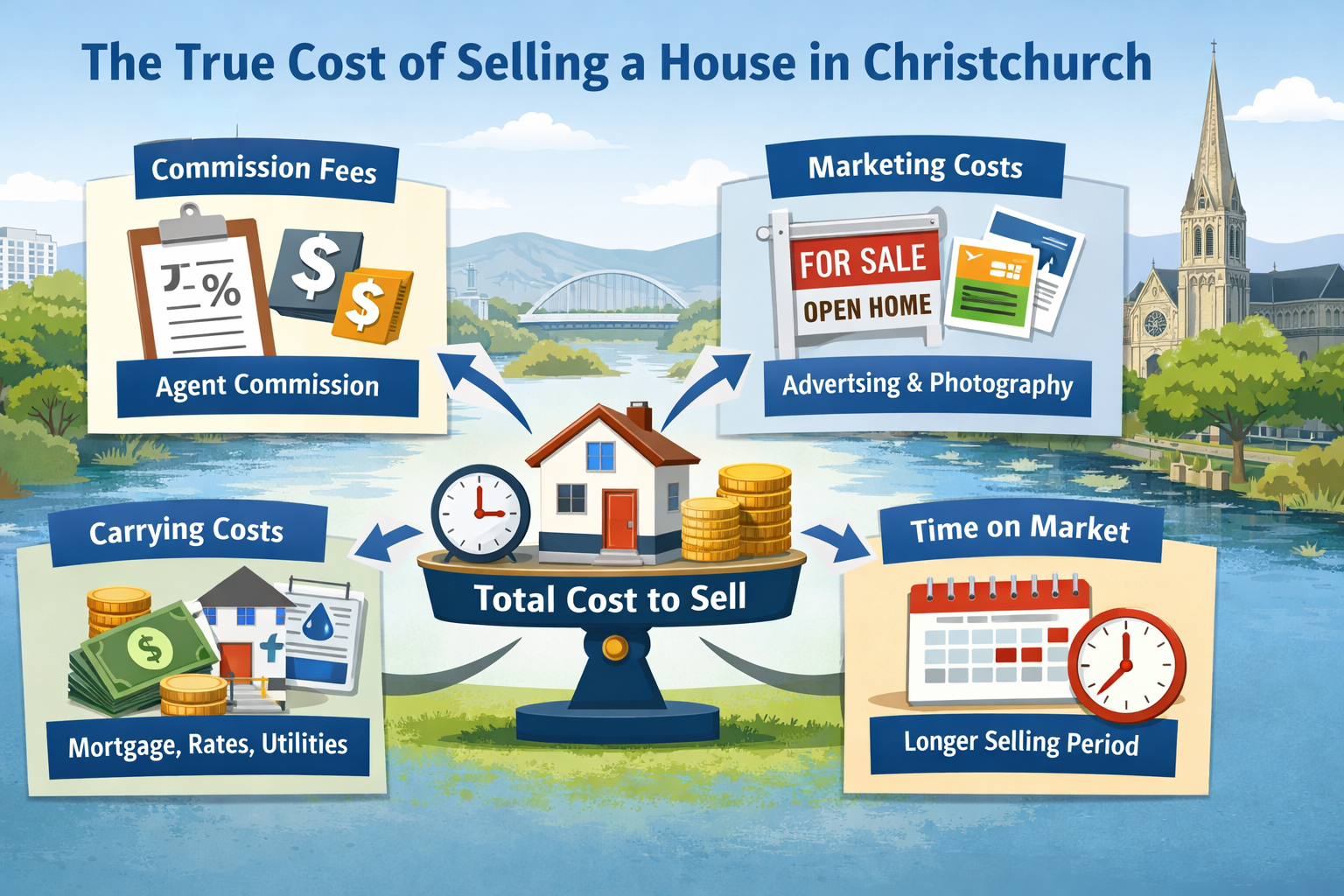
Understanding Commission as a Decision Cost
Real estate commission is often framed as a simple percentage paid at settlement. In practice, it is one of several interconnected costs that shape how a sale unfolds, how long it takes, and who carries risk during the process.
In Christchurch, commission structures are broadly similar across agencies, but the true cost of selling extends beyond the headline rate. Understanding this requires separating explicit fees from implicit costs that arise from incentives, timing, and market exposure.
This page explains how commission works, what it typically includes, and how it influences seller outcomes.
How Real Estate Commission Is Structured in Christchurch
Most residential sales in Christchurch use a commission model that combines:
- A base commission percentage applied to the sale price
- Additional charges for marketing, advertising, or premium listing services
While exact percentages vary by agency and property value, the structure is consistent: the agent is compensated only once the property sells, and the amount scales with price rather than effort or duration.
This creates a clear incentive alignment around achieving a sale, but a weaker alignment around maximising net outcome after time and stress are considered.
What Commission Usually Covers — and What It Does Not
Commission typically covers the agent’s role in:
- Pricing advice and appraisal
- Listing preparation and coordination
- Marketing campaign management
- Buyer enquiries and negotiations
- Contract facilitation through to settlement
It does not usually cover:
- Legal fees
- Pre-sale repairs or staging
- Holding costs during the listing period
- Opportunity cost of delayed settlement
These additional costs are borne entirely by the homeowner and are often more variable than the commission itself.
The Hidden Cost: Time, Exposure, and Carrying Risk
Commission is paid once. Time-related costs accrue continuously.
Every additional week on the market can introduce:
- Mortgage interest and rates
- Insurance and maintenance expenses
- Vacancy or lost rental income
- Emotional and cognitive load from ongoing uncertainty
In slower market conditions, properties may remain listed longer than expected, increasing these costs without changing the commission outcome.
From a decision perspective, commission should be evaluated alongside expected time on market, not in isolation.
Incentives and Outcome Shaping
Because commission is proportional to sale price but insensitive to time, agents are often economically indifferent between:
- Achieving a slightly higher price after a long campaign, or
- Securing a faster sale at a modest discount
For many homeowners, however, these two outcomes are not equivalent.
Understanding this incentive gap helps explain why some sellers feel misaligned during the selling process, particularly if circumstances change mid-campaign.
When Commission Makes Sense — and When It Should Be Reconsidered
Commission-based selling can work well when:
- The property is standard and broadly appealing
- Market conditions are strong
- The seller is not time-constrained
- Carrying costs are manageable
It becomes more questionable when:
- The property requires significant work
- Certainty matters more than price optimisation
- Timing constraints exist
- The seller wants cost clarity upfront
The key is not whether commission is “high” or “low”, but whether the structure fits the seller’s real constraints.
Summary: Commission as Part of a Wider Cost System
For many homeowners, commission is only one part of a broader selling decision that also includes time, uncertainty, and personal constraints. Understanding how these factors interact is often more important than focusing on a single cost in isolation. A more complete way to think through this process is outlined in our guide on selling my house in Christchurch, which explains how different selling paths affect outcomes depending on circumstances.
Real estate commission in Christchurch is only one component of the cost of selling. Its true impact emerges when considered together with time, uncertainty, and risk transfer.
A rational evaluation asks not just “What is the percentage?”, but “What does this structure mean for my situation?”


